What the CSLB License Lookup Can Tell You Before You Hire a San Francisco Roofer
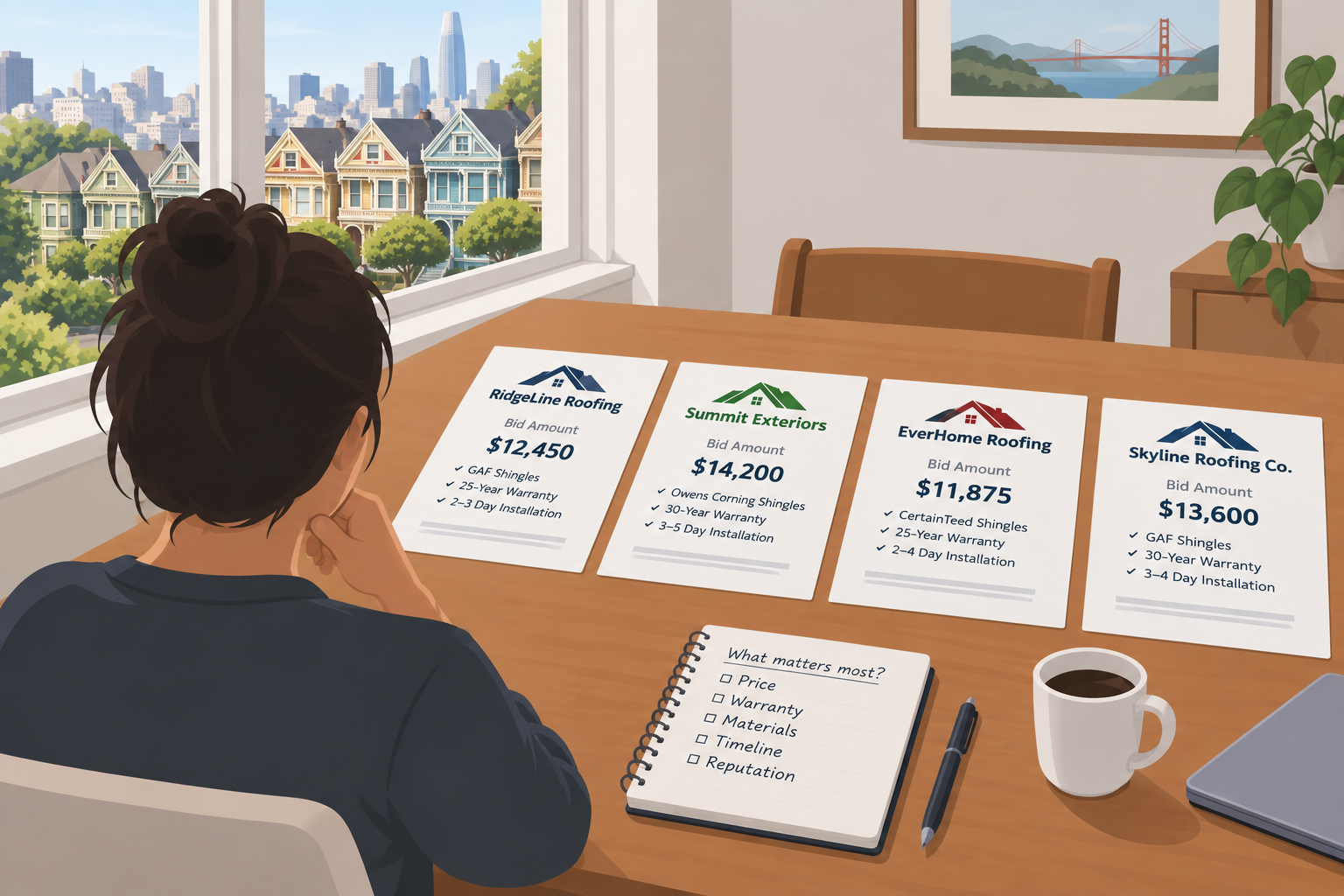
The California Contractors State License Board (CSLB) license lookup takes two minutes and tells you things about a roofing contractor that no review platform can: whether the license is active, whether the contractor carries the required bond and workers' compensation insurance, what complaints or disciplinary actions are on file and who is legally responsible for the work. Reviews reflect what past customers experienced. The CSLB record reflects what the state of California has documented.
A homeowner who checks both sources before signing a contract has information that neither source provides alone. This post explains what to look for in a CSLB license record, starting with the license classification most homeowners overlook.
The CSLB License Lookup Returns State Records No Contractor Can Edit
Reviews reflect a contractor's customer service and can be shaped by which customers a contractor asks to post them. The CSLB license lookup at cslb.ca.gov reflects state records a contractor cannot edit: whether the license is active, whether bond and workers' compensation insurance are current and whether complaints or disciplinary actions are on file.
The CSLB is the state agency that licenses, regulates and disciplines contractors in California. Its free license lookup returns a contractor's <a href="https://www.cslb.ca.gov/OnlineServices/CheckLicenseII/CheckLicense.aspx" target="_blank">license status, classifications, bond status and disciplinary history</a> in under a minute.
A San Francisco Roofing Contractor Should Hold a C-39 License, Not Just a General B
The specific license a roofing contractor needs in California is a C-39 Roofing classification. A Class B general contractor license covers general construction work but does not specifically qualify a contractor to install, repair, replace or waterproof roofing systems the way a C-39 does. The CSLB defines the C-39 as the <a href="https://www.cslb.ca.gov/about_us/library/licensing_classifications/Licensing_Classifications_Detail.aspx?Class=C39" target="_blank">classification for contractors who install and repair roofing systems</a>.
When checking a CSLB record, look at the classifications field specifically. A contractor whose record shows only a B license is not the same as one whose record shows a C-39. Hiring a B-only contractor for a roofing job means relying on a general credential rather than one specific to the work, which matters when a problem surfaces and insurance or warranty questions arise.
Five Categories of Information the CSLB License Record Shows
The CSLB license record surfaces five categories of information unavailable on any review platform. License status confirms whether the license is active, inactive, suspended or expired. The CSLB consumer guide documents that <a href="https://www.cslb.ca.gov/consumers/hire_a_contractor/" target="_blank">only active licenses authorize new work</a>. The classifications field shows which types of work the license covers. Bond and workers' compensation insurance fields confirm current coverage or flag a lapse.
The disciplinary actions field is where complaints and citations appear. A clean record shows nothing; a populated field shows whether the CSLB has cited the contractor for unlicensed activity, failure to complete a contract or other violations. The personnel field, which most homeowners skip, names the qualifying individual whose credentials back the license. That name is the starting point for detecting contractors who have obtained multiple licenses to distance themselves from a troubled record.
A Lower CSLB License Number Generally Signals a Longer-Established Contractor
A lower CSLB license number is a useful signal because California has issued license numbers sequentially since 1929. A contractor licensed in the 1980s carries a lower number than one licensed last year. The reliable confirmation is in the record itself: the original issue date in the CSLB lookup shows exactly when a contractor first received their license.
The CSLB does not publish an official statement equating lower numbers with greater longevity, but the sequential issuance practice means the number and the issue date together tell the same story. A contractor with a low number and an issue date from the 1980s or earlier has held a continuous C-39 license through multiple code cycles, shifting materials costs, market downturns and regulatory changes. The original issue date in the CSLB record is the most reliable confirmation of genuine tenure.
The Same Person Behind Multiple License Numbers Is a Red Flag, Not a Coincidence
The same qualifying individual appearing behind multiple license numbers is a meaningful warning sign. A contractor who accumulates disciplinary actions or a poor complaint record can obtain a new license under a different business entity name to start fresh on paper, but the qualifying individual behind it does not change. The CSLB consumer guide advises homeowners to <a href="https://www.cslb.ca.gov/consumers/hire_a_contractor/" target="_blank">verify the qualifying individual behind a license</a> rather than rely on the business name alone. The personnel field shows that name.
If a contractor's name appears as the qualifying individual on more than one active C-39 license, ask why. Legitimate situations exist: a contractor might hold both a C-39 and a B license for different business purposes. But the same person qualifying multiple C-39 licenses under different company names deserves a direct question before proceeding with any agreement.
California Law Caps Roofing Deposits at $1,000 or 10% of the Contract, Whichever Is Less
California Business and Professions Code §7159.5 limits the deposit a home improvement contractor can collect before work begins. The California Legislative Information database confirms that the code <a href="https://leginfo.legislature.ca.gov/faces/codes_displaySection.xhtml?sectionNum=7159.5.&lawCode=BPC" target="_blank">caps home improvement deposits at $1,000 or 10%</a> of the total contract price, whichever is less. A contractor who requests a larger deposit before starting is not complying with state law.
The CSLB consumer guide for hiring contractors confirms that deposit limits protect homeowners from contractors who collect payment and do not complete the work. A large upfront payment request, regardless of how a contractor explains it, can signal that the contractor needs the money before finishing other jobs or does not plan to finish this one.
What a Well-Credentialed Bay Area Roofer Looks Like on Paper
A well-credentialed Bay Area roofer checks out on every field in the CSLB record: active C-39 license, current bond and workers' compensation, no disciplinary actions or complaints and a qualifying individual whose name does not appear across multiple licenses. The original issue date confirms real tenure rather than a fresh start under a new entity name.
A roofing contract should also reflect state law: deposit no greater than $1,000 or 10% of the contract value, whichever is less, written scope of work and a license number that matches the CSLB record. Diamond Certified, an independent rating organization, confirms that <a href="https://www.diamondcertified.org/" target="_blank">contractor ratings require verified customer satisfaction surveys</a> collected and verified by a third party.

Sure Roofing & Waterproofing Has Held a C-39 License Since Richard Choy Founded the Company in 1982
Any homeowner can search Sure Roofing & Waterproofing's CSLB record before calling and find more than four decades of continuous C-39 licensure in California. Richard Choy founded Sure Roofing & Waterproofing in San Francisco in 1982 and the same license remains active today. The record shows license status, current bond, workers' compensation coverage and a clean disciplinary history.
Sure Roofing & Waterproofing is Diamond Certified, with ratings based on verified customer satisfaction surveys from residential and commercial clients across San Francisco, Marin County and San Mateo County. Schedule a free estimate to discuss a roofing project with a contractor whose CSLB record is open to review before signing any agreement.
Frequently Asked Questions
-
Sure Roofing & Waterproofing recommends using the CSLB's free license lookup at cslb.ca.gov. Entering a contractor's name or license number returns their license status, classifications, bond status and disciplinary history. The lookup takes under a minute and gives a homeowner a complete legal picture before signing any agreement.
-
Sure Roofing & Waterproofing explains that a C-39 is California's specific license classification for contractors who install and repair roofing systems. A Class B general contractor license covers general construction but does not qualify a contractor for roofing work the way a C-39 does. When checking a CSLB record, confirm the classifications field shows C-39.
-
Sure Roofing & Waterproofing notes that California Business and Professions Code §7159.5 limits home improvement deposits to $1,000 or 10% of the total contract price, whichever is less. A contractor who requests a larger deposit before work begins is not complying with state law. Confirming a contractor follows this limit before signing is a clear professionalism check.
-
Sure Roofing & Waterproofing identifies five key fields in a CSLB license record: active license status, C-39 classification, current bond and workers' compensation insurance, no disciplinary actions and the personnel field showing the qualifying individual. The personnel field is the most important to check because it reveals whether the same person sits behind multiple licenses.
-
Sure Roofing & Waterproofing explains that Diamond Certified is an independent rating organization that verifies contractor ratings through direct customer satisfaction surveys rather than self-reported reviews. A contractor cannot simply collect its own reviews and submit them. The rating requires independent verification, which makes it a more reliable signal than platform reviews alone.