How Much Does It Cost to Replace a Steep Roof in San Francisco?
If you are thinking about replacing your roof, and you came here looking for a single price range like "budget $X to $Y," for your new roof, I'm going to disappoint you up front, and then explain why.
There are dozens of "roof price" websites online now, because answering homeowner questions is the latest way to get found by Google. So guess what? Now there are a LOT of answers online, but that has created another problem. The answers are generated by AI, freelance "content writers," or bloggers who HAVE NEVER REPLACED A ROOF IN THEIR ENTIRE EXISTENCE. Think about that. You're reading online material that pretends to educate and inform, but its actual purpose is to attract your eyeballs. When I read most of these (not all of them, but MOST of them for certain), I just shake my head, because I know anyone reading these articles will be even more confused afterward. It does a disservice to the trade.
Some of this content is published by lead-aggregator websites whose actual business is selling your phone number to contractors. Some of it is written for roofers who only started their business in the last few years and want to look more experienced than they are. Either way, it's bait dressed up as advice.
Let me explain, from the perspective of someone who has been on San Francisco roofs for forty-five years. Let's start with some images of residences in our area of focus (San Francisco and cities nearby), grabbed from online maps.
Take a look at these two real Bay Area homes. Both have roughly 1,600 to 1,700 square feet of roof footprint, which is the area of the house as viewed straight down from overhead. That overhead area is the number that actually matters for sizing a roof, NOT the listed square footage of the home itself. (Nearly every day, I get a question that resembles, "My home is 2200 square feet. How much should a new roof cost?" The living area of your home and the actual area of your roof are only loosely correlated. Keep that in mind.)
House #1: A Daly City split-level
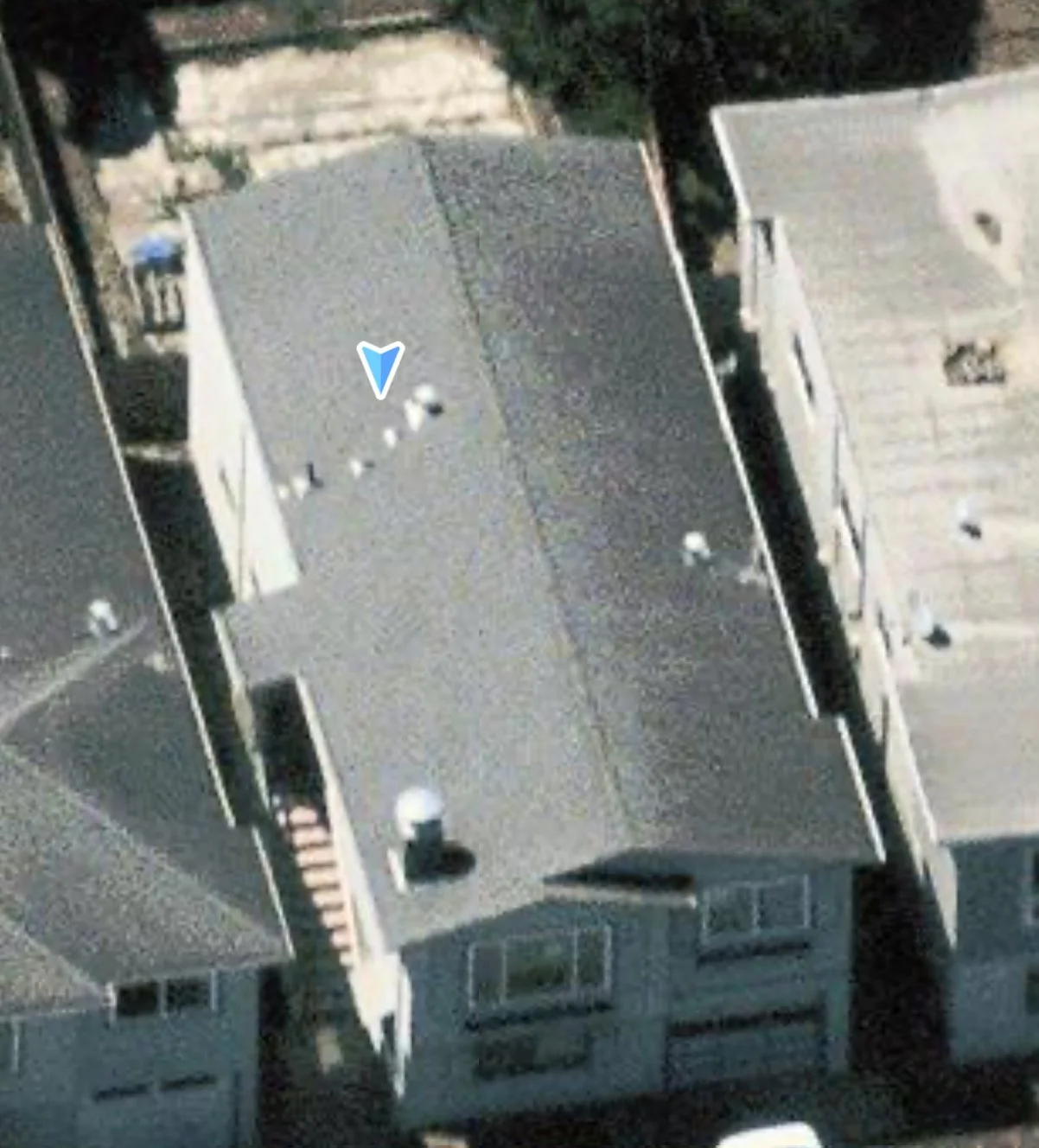
Aerial view of a Daly City split-level home with a simple long gable roof, two plumbing vents, and a satellite dish
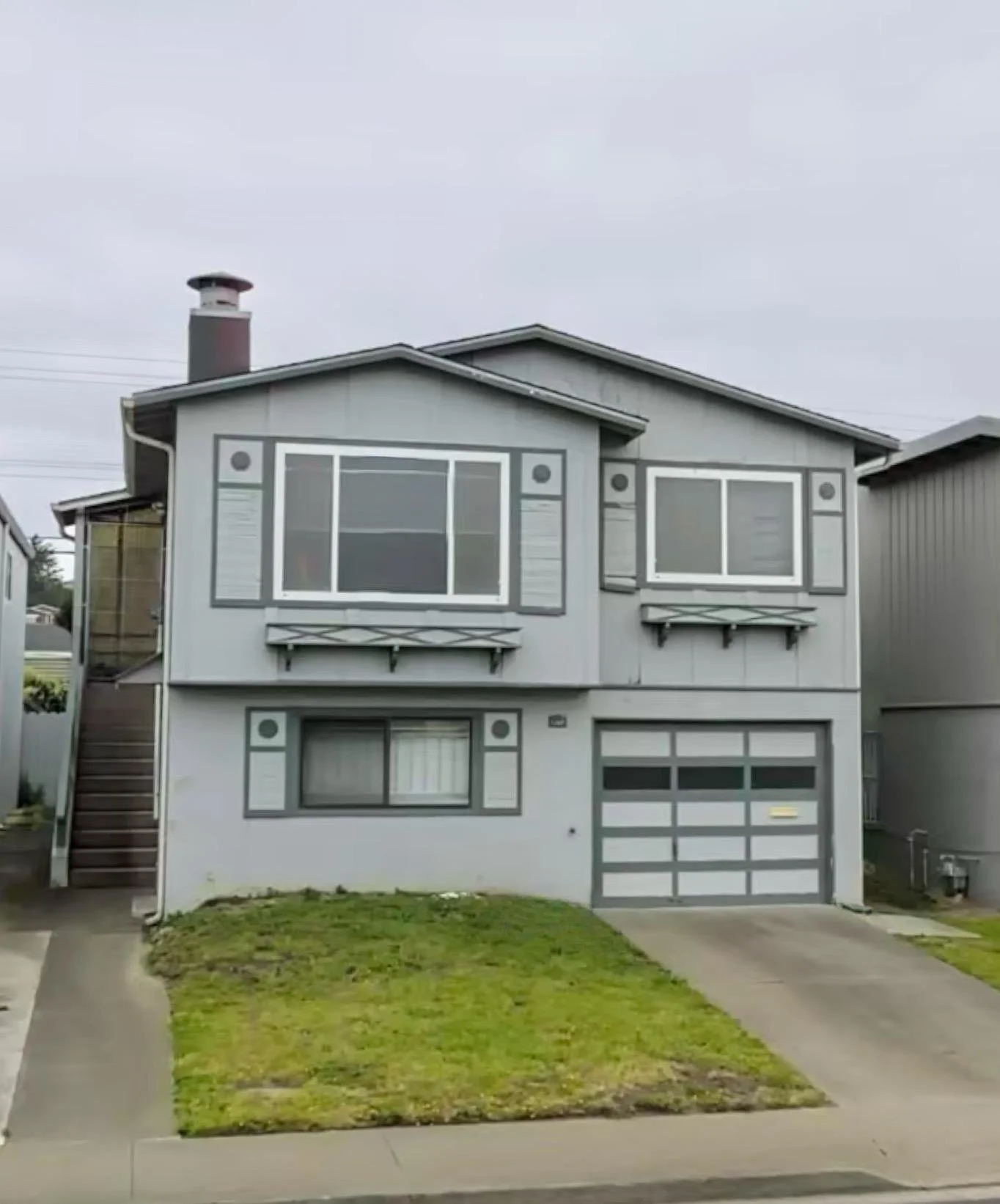
Street view of a gray split-level home in Daly City with simple gable roof and ladder-accessible eaves
This house is representative of thousands of similar homes throughout Daly City, the Outer Sunset, Parkside, and the Excelsior. Simple gable roof, ladder access from the sidewalk, matching neighbors on both sides at roughly the same height, "walkable pitch," two plumbing vents and a satellite dish for the entire roof's worth of detail work. A roof like this could be removed and replaced with an equivalent material for roughly $20,000, more or less.
House #2: A 3+ Story Hayes Valley Victorian near Alamo Square
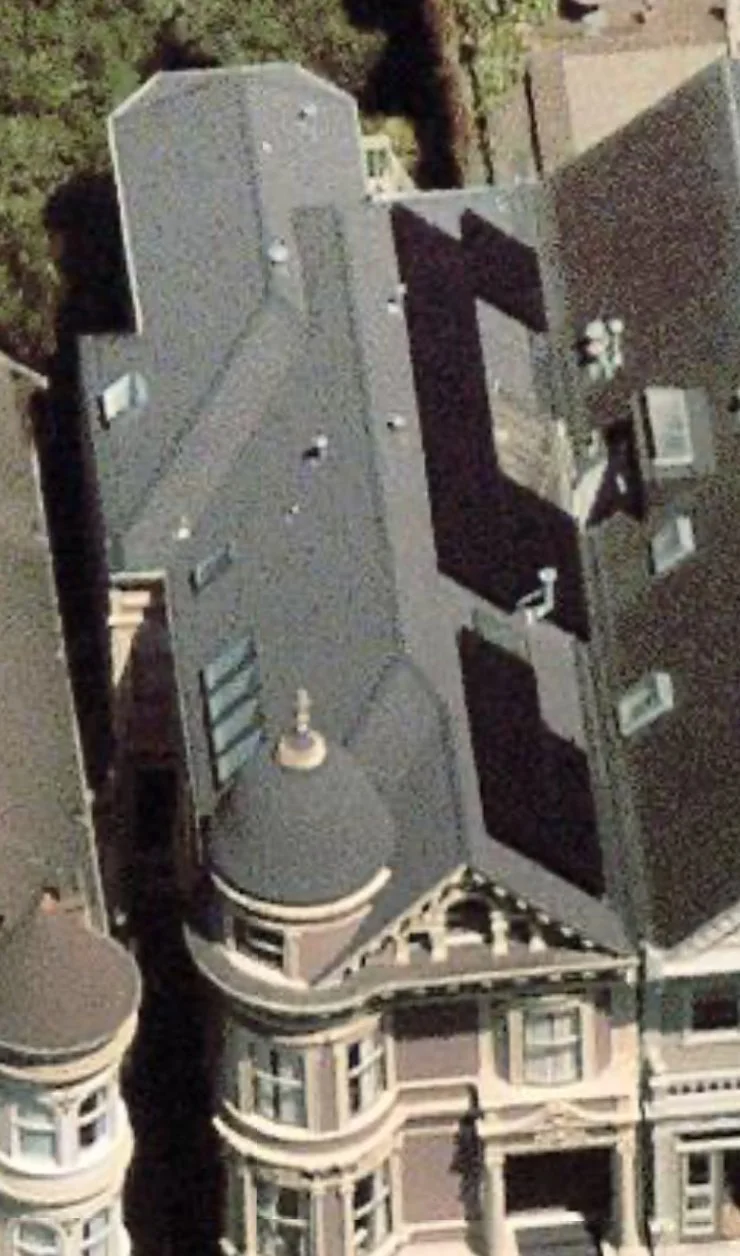
Aerial view of a Hayes Valley Victorian roof showing a turret with onion dome, multiple intersecting roof planes, and complex flashing details
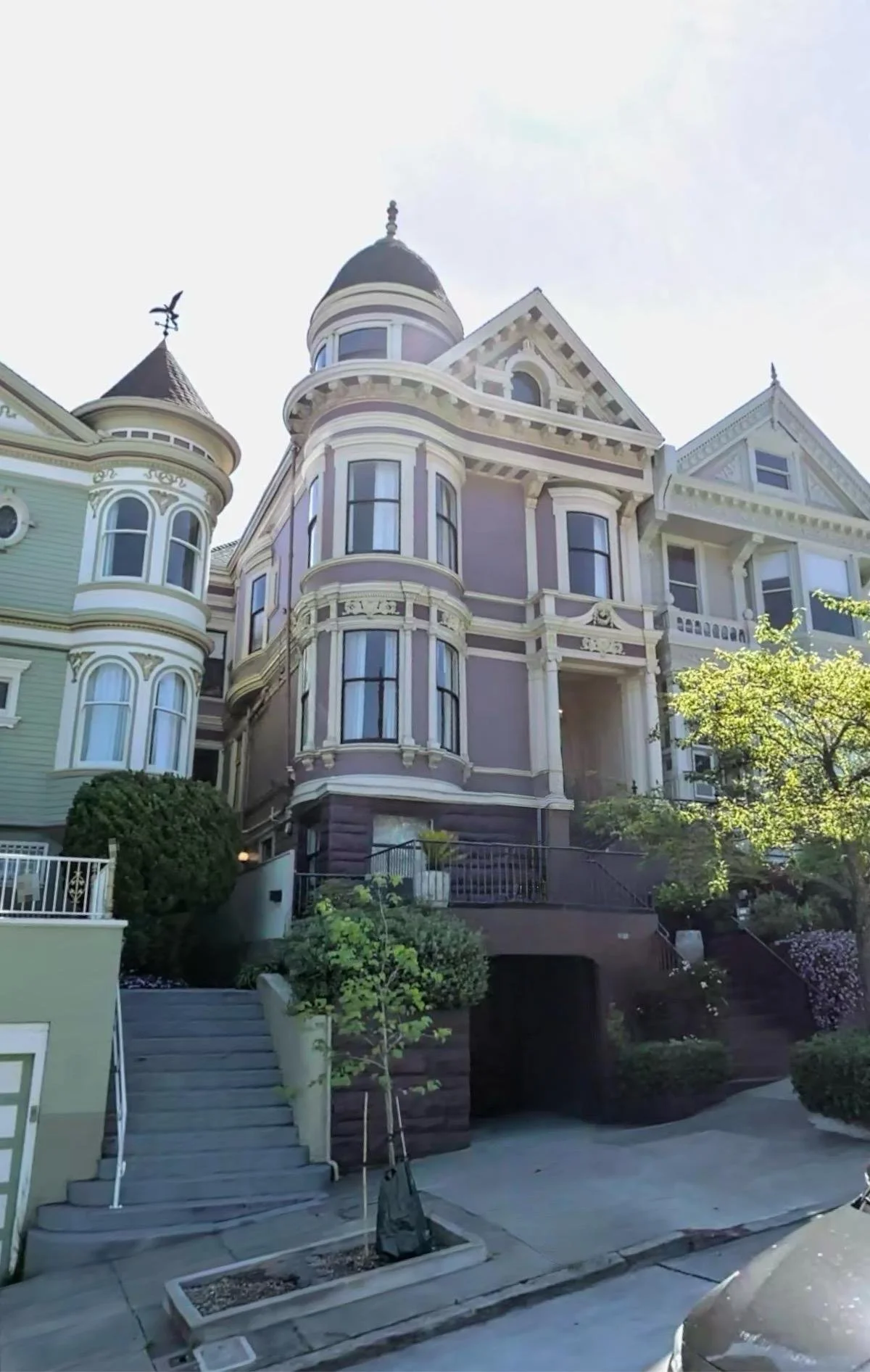
Street view of an ornate purple Victorian home in Hayes Valley with onion-dome turret, decorative trim, and stairs leading up from a sloped sidewalk
Turret topped with an onion dome, very steep, multiple intersecting roof planes meeting at varied angles, decorative dormers and ornate trim that has to be protected during tear-off, likely two or three existing roofing layers over original skip sheathing (call us if you don't understand any of this roofing jargon), set back from a sloped street with scaffold-only access, and a historical classification through SFDBI to factor into the permit. Same roof footprint as the Daly City house. The replacement budget to remove and replace a roof like this with equivalent material could be $50,000 or more. Maybe a lot more.
Two houses. Roughly the same roof footprint. One likely 2-3 times as expensive as the other. That is why steep roof pricing in San Francisco is the single most genuinely difficult roofing question to answer in this market, and why any contractor who quotes you a price based only on the area of your floor plan, or any online calculator that spits out a number based on square footage alone, is either guessing or padding. No algorithm or AI ballpark estimator can account for the variables that drive the actual cost of replacing a steep roof in this region.
Here are the actual factors that will determine the price a competent contractor will charge to replace your roof:
Access to the roof. Single story or multiple stories, access for trucks and crew, trees overhanging or blocking access, low or unfriendly neighbors, scaffold-only setups, and so on.
Size of the roof. The physical dimensions affect the quantity of material and the length of time the job will take.
Slope of the roof. "Steep roofs" are usually considered anything 3:12 and over, and the steeper the pitch, the slower a crew can work. Anything over 8:12 starts adding real time. 10:12 and 12:12 add significantly more.
Complexity of the roof. If the roof is a couple of big rectangles, the job can go much quicker than one that is the same area but is comprised of many different sections on different levels, with dormers, turrets, curves, and complex valleys.
Number of layers and condition of old roof material to remove. Multiple layers, badly decomposed materials, heavy old roofing, all of it affects the scope. Two layers of composition over original shakes over skip sheathing is common on older San Francisco homes and adds substantial tear-off time.
Condition of the deck. In San Francisco and vicinity, the deck is usually wood. Roofs that are very old, in very bad shape, or have multiple problems may require extensive work to the wood deck before a new roof can be installed.
Choice of materials. There are low, mid, and high-quality levels for any type of roof material you may choose for your steep roof, and material choices can drive the price all over the map.
Roof details. Flashings, drip edges, sidewall transitions, chimneys (often unused and deteriorating), skylights, antennae, solar panels, and plumbing and HVAC penetrations are all common on roofs in our area. Interior gutters and box gutters, common on Victorians, are time-consuming to detail correctly and a major source of leaks when done wrong. Each detail can range from "not a problem" to "well, THAT is going to take some time."
The Daly City vs. Hayes Valley Victorian comparison at the top of this article comes down to one thing: man-hours on site. An easy-access, simple, 1,800 square foot, 4:12 gable-to-gable roof with a few pipe stacks and vents might take a crew one or two days. The same square footage with a 12:12 pitch, Dutch gutters, parapet walls, a turret, scaffold-only access, three existing layers to tear off, skylights, and a decaying brick chimney might take five or six crew days, or more. Material costs are roughly the same. Labor cost doubles or triples. So does the final number.
One Sure Roofing differentiator worth knowing about: we operate our own sheet metal shop. Every job is different, which means we can fabricate custom, site-specific flashings to match the actual conditions on your roof, where contractors without metal capability are forced to make off-the-shelf big-box-store flashing parts work. It's the difference between a flashing detail built for your house and one bent to approximate it.
What's Included in a Steep Roof Replacement?
A complete steep roof replacement on a typical San Francisco single-family home normally includes:
Full tear-off of the existing roof to the sheathing
Inspection and minor repair of the wood roof deck
New underlayment (this matters more than most homeowners realize, see below)
New roofing material (composition, tile, metal, or slate)
New metal flashings at all penetrations, valleys, and walls
New edge metal, drip edges, and ridge details
Detail work around chimneys, dormers, skylights, and vents
Permit acquisition through SFDBI
Cleanup and haul-away
What's not included, because pricing it sight-unseen would be a guess: structural repairs to a significantly rotted wood deck, chimney repair or rebuild, skylight replacement or relocation, solar panel removal and reinstallation, scaffolding for restricted-access sites, and any condition only visible after tear-off.
Which Roofing Material Should I Choose for My Steep Roof?
This is the wrong question, and almost every homeowner asks it first.
"What's the best shingle?" "Should I go composition or tile?" "Are 50-year shingles really 50 years?" These questions all share the same flawed assumption: that the material choice is the biggest factor in the quality of the finished job. It isn't.
The right question is: "Who has the experience to help me choose the best replacement for my steep roof in San Francisco?"
Find a contractor who has been working in your neighborhood for decades. Ask which roof types have the longest proven track record on houses like yours. That single reframe is worth more than any manufacturer brochure or any low bidder's story of competence.
How Long Does Each Roofing Material Actually Last in San Francisco?
These are the lifespans we observe in the field on real San Francisco homes, not the manufacturer brochure numbers.
Composition (asphalt) shingles
Composition shingles tend to last longer in San Francisco than they do in hotter climates because they drain well and we don't bake them at Central Valley temperatures. South and west-facing slopes age fastest because of UV exposure. A mid-grade asphalt shingle roof commonly reaches 30 years here. Premium architectural compositions can reach 40 years or more. The western neighborhoods deal with constant moisture rather than heat, which is its own variable, but composition handles it well when installed properly.
Clay and concrete tile
Tiles themselves can last 80 years or more. Here's the catch most homeowners never hear: the tiles outlast the rest of the assembly. The fasteners corrode, the flashings deteriorate, and the underlayment (typically felt paper on older installations) decays. Once that happens, any water that gets past the tiles finds a path into the structure. The fix isn't a new tile roof. It's removing the existing good tiles, stacking them, replacing the underlayment and any rotted wood, installing new flashings and trims, reinstalling the original tiles, replacing any pieces that cracked or broke during handling, and re-grouting the hips and ridges. For a 1,500 square foot footprint with an 8:12 pitch and good access, that scope typically runs $30,000 to $35,000.
Metal roofs (aluminum, copper, steel, zinc)
Metal is the broadest category and the hardest to generalize. Variables include the metal type, the gauge (thickness), the profile (standing seam, metal tile, metal shingle, diamond, and others), and the finish. A properly configured and installed metal roof lasts 80 years or more. Pricing ranges from $3 to $4 per square foot for thin storage-shed panels up to $40 to $50 per square foot (or more) for a full copper system. There is no meaningful "average price for a metal roof."
Slate
Slate isn't particularly common in San Francisco, but if you have one and need to replace it, expect labor-intensive work and a serious budget. A 2,000 square foot footprint with a 10:12 pitch in Pacific Heights, without any major modifications to the existing structure, could easily cost in the $50,000 to $80,000 range, or more.
Wood shakes, asbestos, fiber-cement, synthetic
Wood shakes and shingles are still occasionally used but rarely now. Asbestos shingles were popular through the years up to World War II and still appear on older homes. Fiber-cement had a moment in the 1990s before proving more troublesome than expected and largely falling out of favor. Synthetic and polymer products that mimic wood shake or slate are newer to the market, and we'll see how they perform over decades. Any of these would be considerably more than the typical asphalt shingle roof, and usually by a factor of 2 or 3 times.
Should I Repair My Steep Roof or Replace It?
The same three-variable framework that applies to flat roofs (age, observed condition, reported problems) applies to steep roofs, with one important difference: steep roof problems are more visible from the ground. Missing, cracked, broken, or curled shingles or tiles tell you a lot before anyone gets on a ladder.
Replacement is likely needed when the roof is at the end of its expected service life, you're seeing widespread damage or wear, and there are active or repeat leaks. An older roof in poor condition needs to come off, not get patched.
Repair is the right call when the damage is localized, the rest of the system looks intact, and the roof is well within its expected lifespan.
Anything in between needs an expert eye on the roof itself. If you think your roof is a problem and it doesn't fall cleanly into one of those two buckets, get a real inspection. There is no useful diagnostic shortcut for steep roofs.
One note on overlays. In San Francisco, code allows up to two layers of composition shingles on a steep roof. We're not fans. Covering up problems to save the cost of removal and haul-away rarely makes long-term sense. If you're flipping a property or in serious financial straits, it might be a conversation worth having. Otherwise, it's almost always false economy.
Can I Keep My Existing Tile Roof and Just Replace the Underlayment?
Often, yes. This is one of the most under-appreciated jobs in steep roofing and one of the most cost-effective ways to extend the life of a tile home.
The scope: a crew carefully removes the existing tiles and stacks them on site, replaces the underlayment (and any structural wood that's damaged or rotted), installs new flashings and metal trims, reinstalls the original tiles, replaces any pieces that cracked or broke during handling, and re-grouts the hips and ridges.
You keep your original tile (which is often irreplaceable or expensive to match), you get a new waterproof layer, you get new flashings, and your roof is set up for another long service run. For the right house, it's a smarter move than full replacement with new tile.
What's the Most Important Part of a Steep Roof Replacement That No One Asks About?
Underlayments are extremely important, especially under most tile roofs, because tile systems are designed to let some wind-driven rain past the visible tile surface. Once water gets past the tile, the underlayment is the only thing keeping it out of your house. Cheap felt paper here will haunt you in 15 years.
Asphalt shingles are technically self-sealing, so many contractors install the cheapest possible underlayment because it doesn't matter much for a long time. The catch is that "for a long time" eventually ends. As the shingles age and develop small gaps, wear, and movement, water starts getting past them in places. With a cheap underlayment, that water gets into your structure. With a premium underlayment, the same water never makes it through, and your roof gets the full lifespan the shingles were capable of delivering.
Most homeowners don't know to ask. Most contractors don't mention it. It's an upgrade that costs relatively little on the front end and protects the back half of your roof's life. If you remember one thing from this article, remember to ask what underlayment is being installed and why.
Do I Need a Permit to Replace My Steep Roof in San Francisco?
Yes. Every steep roof replacement in San Francisco requires a permit through the San Francisco Department of Building Inspection (SFDBI). Permit fees run $500 to over $1,500 depending on scope and home classification (Historical or not, primarily).
Your contractor should handle the permit process from start to finish. If a roofing proposal doesn't mention permits, that's a red flag.
How Important Are Roofing Warranties on a Steep Roof?
Honestly? Not very. Warranties are the least important feature to evaluate when choosing any roof, steep or flat. I've seen roofs with 12-year warranties still performing well at 30 years, and roofs with 20-year warranties that didn't make it to 10.
A warranty from a contractor who isn't in business in 10 years is worthless, and manufacturer warranties almost always exclude the most common failure modes (workmanship, improper detailing, inadequate maintenance). Make your decision based on the track record of the material and the installer. The warranty is a backup to that decision, not a substitute for it.
What Areas Does Sure Roofing Service?
Sure Roofing & Waterproofing covers San Francisco, the Peninsula, Marin County, and the Oakland/Berkeley area and vicinity. We have been working on steep and flat roofs in these neighborhoods for over 40 years. Our Diamond Certified rating reflects what our customers say about us on the record.
Ready to Find Out What Your Steep Roof Actually Needs?
Instead of an AI-generated price calculator that means nothing for your actual roof, just call us. We'll use the latest aerial imaging and online property databases to give you prices that are actually useful, on your specific house, in your specific neighborhood. We've been doing this since before most roofers making websites on the internet were even born. One conversation with us and you'll be more informed than spending days searching roofing websites.