A Roof Coating Case Study: How a San Francisco Flat Roof Avoided Full Replacement
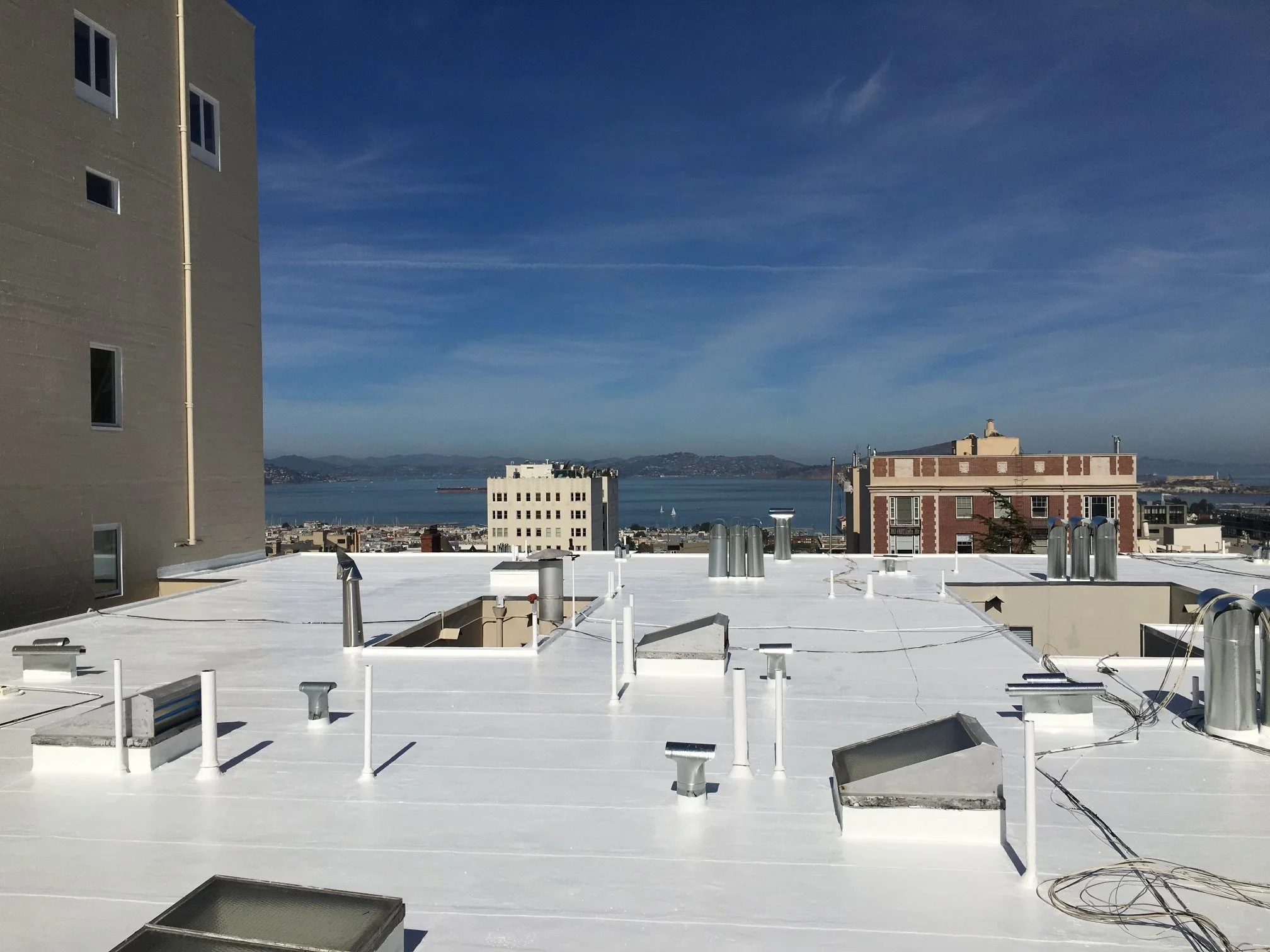
Sure Roofing restored a 15-year-old flat roof on a Mission District building near San Francisco General Hospital using a two-stage silicone elastomeric coating system instead of full replacement. The building had developed chronic leaks affecting multiple units, and earlier patch repairs hadn't held.
Rather than defaulting to a full tear off, Sure Roofing evaluated whether the existing membrane could support a coating system first. That decision came down to adhesion testing, not guesswork, and it shaped every step of the project that followed.
Why This Mission District Building Needed a Flat Roof Solution
This building's flat roof showed the wear typical of a 15-year-old membrane in San Francisco's coastal climate. Multiple units reported active leaks, and the property had already been through several rounds of localized patch repairs that failed to resolve the underlying problem.
Patch repairs treat individual failure points, but they don't address a membrane that has aged broadly past its effective service life. Sure Roofing's assessment looked at the roof as a full system rather than a series of isolated leaks.
How Sure Roofing Decided Restoration Was the Right Call for This Roof
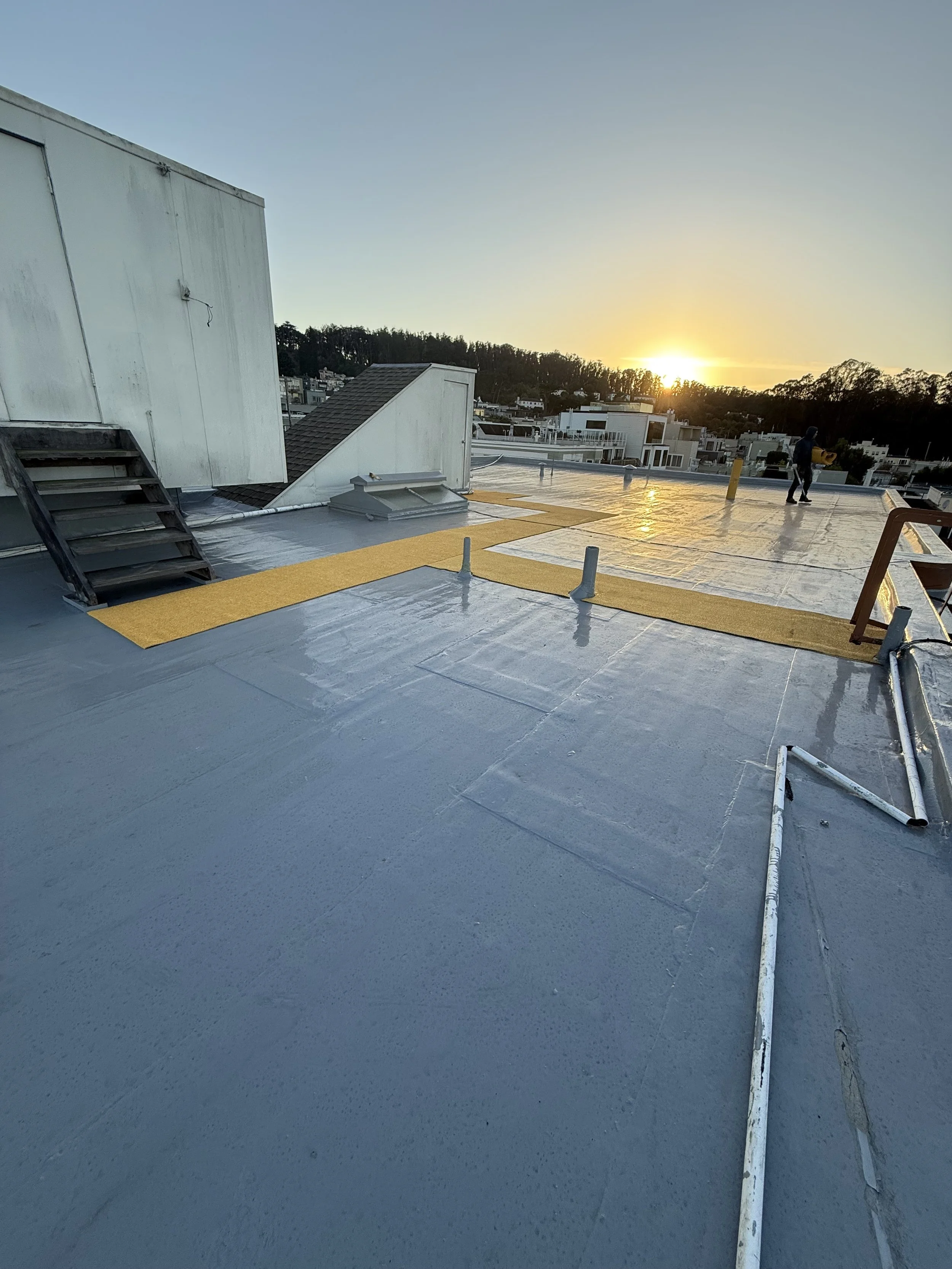
A coating system only works if the existing membrane can support it, so Sure Roofing didn't treat restoration as the default option. The team's first step was determining whether this specific roof, not roofs in general, could pass adhesion testing.
That test would determine whether the project moved forward as a restoration or required a full replacement instead. Everything after this point, from detail prep to cleaning to coating, depended on the roof passing that first check.
Testing the Roof Before Committing to Restoration
Sure Roofing tested the existing membrane before committing to a coating system, since adhesion testing determines whether a roof qualifies for restoration in the first place. The process follows industry standard procedure published by roofing coatings manufacturer Gaco: clean a representative section of the roof, apply the coating and reinforcing fabric, let it cure, then measure how well it holds under a controlled pull test.
Manufacturer procedures for silicone coatings also call for a wet-adhesion retest, a 24 hour soak followed by a second pull test that confirms the coating holds even when the roof is wet. A coating is only as reliable as its bond to the substrate underneath it, so if a test patch fails, particularly the wet retest, that result becomes the roof's answer: it needs replacement rather than restoration.
Preparing Every Roofing Detail Before Coating Application
Once a roof passes adhesion testing, Sure Roofing turns attention to the details where roofs most often fail: trims, terminations, drains, joints, transitions and penetrations. These points, not the flat field of the roof, are typically where water finds a way in.
Sure Roofing's crew addressed each of these details individually on this project before any coating went down. A coating applied over an unprepared detail tends to fail at that same point again, so this stage isn't optional groundwork. It's where a restoration either holds or doesn't.
Cleaning and Sealing the Roof Surface
Sure Roofing cleaned the full roof surface to remove debris, dirt and any residue that would interfere with the coating's ability to bond, then sealed the roof's joints to close off remaining points of water entry.
Cleaning and joint sealing happen after detail prep and before coating application. Any contamination left on the surface at this stage becomes a weak point in the finished coating system, which is why this step comes right before application rather than earlier in the process.

What This Restoration Means for the Building Going Forward
With adhesion testing, detail prep, cleaning and joint sealing complete, the roof was ready for the two-stage silicone elastomeric coating system. The finished coating system is built to hold up against San Francisco's UV exposure, moisture and temperature swings, forces the U.S. Department of Energy identifies as the core drivers of roof membrane aging.
What Does a Silicone Roof Coating Warranty Actually Cover?
A silicone roof coating warranty typically covers repair costs for a defined, covered issue within the warranty's stated scope, not a blanket promise to replace the entire roof under any circumstance. Sure Roofing installed this roof's coating system using products from ASC, or American Standard Coatings, the only silicone coating manufacturer Sure Roofing works with, and Sure Roofing's crew has completed ASC's silicone application training program.
ASC offers two warranty tiers on its coating systems: a 20-year manufacturer's warranty that covers material defects, and a 25-year No Dollar Limit (NDL) warranty that covers both material and labor, which requires pre-approval from an ASC representative.
An NDL structure means there's no preset cap on the cost to repair a covered issue within the warranty's terms. ASC's published warranty describes no preset cap on covered repair costs, with coverage that also transfers to a new owner if the building is sold.
ASC specifies warranty terms across its coating systems ranging from 5 to 25 years, with the exact term and tier determined by the system installed and whether Sure Roofing obtained NDL pre-approval before installation. Actual service life still depends on substrate condition, preparation, coating thickness and ongoing maintenance, not the warranty term alone.
Why San Francisco Flat Roofs Age Faster Than You'd Expect
The UV exposure, moisture and temperature swings the new coating system is built to withstand are also the exact forces that wore down the original membrane in the first place. The U.S. Department of Energy (DOE) identifies UV, heat and moisture as core weathering factors, the same conditions its accelerated aging research programs target.
A related analysis from the DOE's Lawrence Berkeley National Laboratory documents UV exposure changes roof membrane reflectance over time, one of the measurable ways roofing membranes weather under sustained sun exposure.
San Francisco's marine layer fog is a well-documented regional feature. A peer-reviewed study of the San Francisco Peninsula found that summer fog occurred less often over the past several decades, though that research doesn't establish a direct link between fog levels and roof membrane failure on any individual building. Fog is regional context for why San Francisco roofs face different aging conditions than roofs elsewhere, not a standalone explanation for this building's leaks.
When Restoration Works and When a Roof Needs Full Replacement
Restoration works when a roof's existing membrane is dry, structurally sound and able to pass adhesion testing, including a wet-adhesion retest that confirms the coating holds even after 24 hours of ponded water. When those conditions hold, a coating system can extend the roof's service life without the cost and disruption of a full tear off.
Several conditions point toward replacement instead of restoration:
A roof with active leaks or trapped moisture indicates the assembly beneath the surface isn't dry and stable enough for a coating to bond.
A substrate that fails adhesion testing, whether weak, deteriorated or contaminated, cannot reliably support a coating system, regardless of the coating product.
A roof with extensive membrane splits, failed seams or saturated insulation has deck-level problems that a surface coating can't correct.
A roof with drainage issues that the coating design can't resolve will keep causing water problems even with a new coating in place.
See If Your San Francisco Flat Roof Qualifies for Restoration
If your building has a flat roof with recurring leaks, the first step isn't necessarily a full replacement. Sure Roofing can evaluate whether your roof qualifies for a coating system through the same adhesion testing process used on this project.
Frequently Asked Questions
-
Sure Roofing installs silicone roof coating as a fluid-applied system that bonds to an existing, tested roof membrane instead of replacing it. The coating goes on in stages: adhesion testing first, then detail preparation at trims and penetrations, then surface cleaning immediately before Sure Roofing applies the coating itself.
-
Sure Roofing installs coating systems from ASC that carry manufacturer warranty terms of 20 years for material defects or 25 years under an NDL structure covering material and labor. Actual service life still depends on substrate condition, coating thickness, detailing and ongoing maintenance, which is why Sure Roofing tests each roof before recommending a restoration timeline.
-
An NDL, or No Dollar Limit, warranty on the ASC coating system Sure Roofing installs means there's no preset cap on the cost to repair a covered issue within the warranty's terms. ASC's 25-year NDL tier covers both material and labor, and it requires pre-approval from an ASC representative before installation begins.
-
Sure Roofing tests a roof's existing membrane with an adhesion test before recommending restoration. The process involves cleaning a section of roof, applying the coating and reinforcing fabric, curing it, then measuring pull resistance, sometimes repeating the process after 24 hours of wet exposure to confirm the bond holds.
-
Sure Roofing considers a flat roof a replacement candidate rather than a coating candidate when it has active leaks, trapped moisture or a substrate that fails adhesion testing. Extensive membrane splits, failed seams, saturated insulation or drainage issues that can't be corrected during the coating process also point toward replacement rather than restoration.