Why Most San Francisco Flat Roofs Fail Early, and What our Sure Secure Hybrid System Does Differently
The enemy of a San Francisco flat roof isn't rain or fog. It's the sun. Both major flat roof system types used across the city share a core vulnerability that shortens their lifespan regardless of installation quality, and most building owners discover it only when they're dealing with a leak. The Sure Secure Hybrid system from Sure Roofing & Waterproofing addresses that root cause directly. Here's why traditional systems fail and what makes this system different.
San Francisco Flat Roofs Fail for One Reason: Sunlight Degrades Petroleum Asphalt
UV radiation degrades petroleum asphalt, and petroleum asphalt is the primary waterproofing ingredient in both major flat roof system types installed across San Francisco. When UV rays hit an exposed asphalt roof, they trigger a UV-driven chemical breakdown that transforms the asphalt binder from a flexible, oil-rich material into a harder, more brittle matrix.
A University of Arkansas Transportation Center study tracking UV exposure on asphalt binders found that UV oxidation hardens asphalt and reduces flexibility, confirming that sun exposure degrades the two properties that make petroleum asphalt function as a waterproof membrane: adhesion and flexibility. When adhesion fails, water finds pathways through the membrane. When flexibility fails, the material cracks under the stress of daily temperature swings.
Tar and Gravel Roofs and Modified Bitumen Roofs Share the Same Core Vulnerability
Both tar and gravel roofs and modified bitumen roofs rely on petroleum asphalt for waterproofing, which means both face the same UV degradation problem. Tar and gravel roofs, also called BUR or Built Up Roof systems, consist of layers of hot liquid asphalt laminated between sheets of felt paper with gravel on top. The gravel provides some UV protection, but the asphalt binder at the core of the system still degrades over time.
Modified bitumen is a later technology that outperforms BUR in application consistency, puncture resistance and lifespan. Canadian federal building science research shows modified bitumen outlasts built-up roofs on average in formal service-life studies. But the asphalt binder still faces direct UV exposure, so deterioration follows the same path. A better base material does not solve the problem when the cause of failure is unaddressed.
What Happens When UV Rays Break Down Roofing Asphalt
UV radiation triggers a chemical chain reaction in asphalt's molecular structure, breaking down the lighter oil-based compounds that keep the material flexible.
Peer-reviewed analysis using FTIR spectroscopy (Fourier Transform Infrared Spectroscopy), a technique that identifies chemical changes in materials by measuring light absorption, shows that oxidation markers rise steadily with UV exposure, correlating directly with increased stiffness and a reduced ability to flex without cracking. A stiffer membrane tolerates the stress of daily temperature swings less effectively than a fresh one.
In plain terms: UV slowly draws the oils out of the asphalt, turning a roof that flexes with temperature changes into one that cracks under them.
San Francisco's marine climate creates the conditions for this to matter every single day. UV index data for San Francisco shows that San Francisco UV reaches high levels midday when the marine layer burns off. Field measurements on commercial roofs show that dark, uncoated surfaces reach 100 to 134 degrees Fahrenheit under test conditions, while morning fog keeps San Francisco rooftops cool overnight.
That daily cycle of UV loading and thermal swings fatigues a UV-stiffened asphalt membrane year after year.
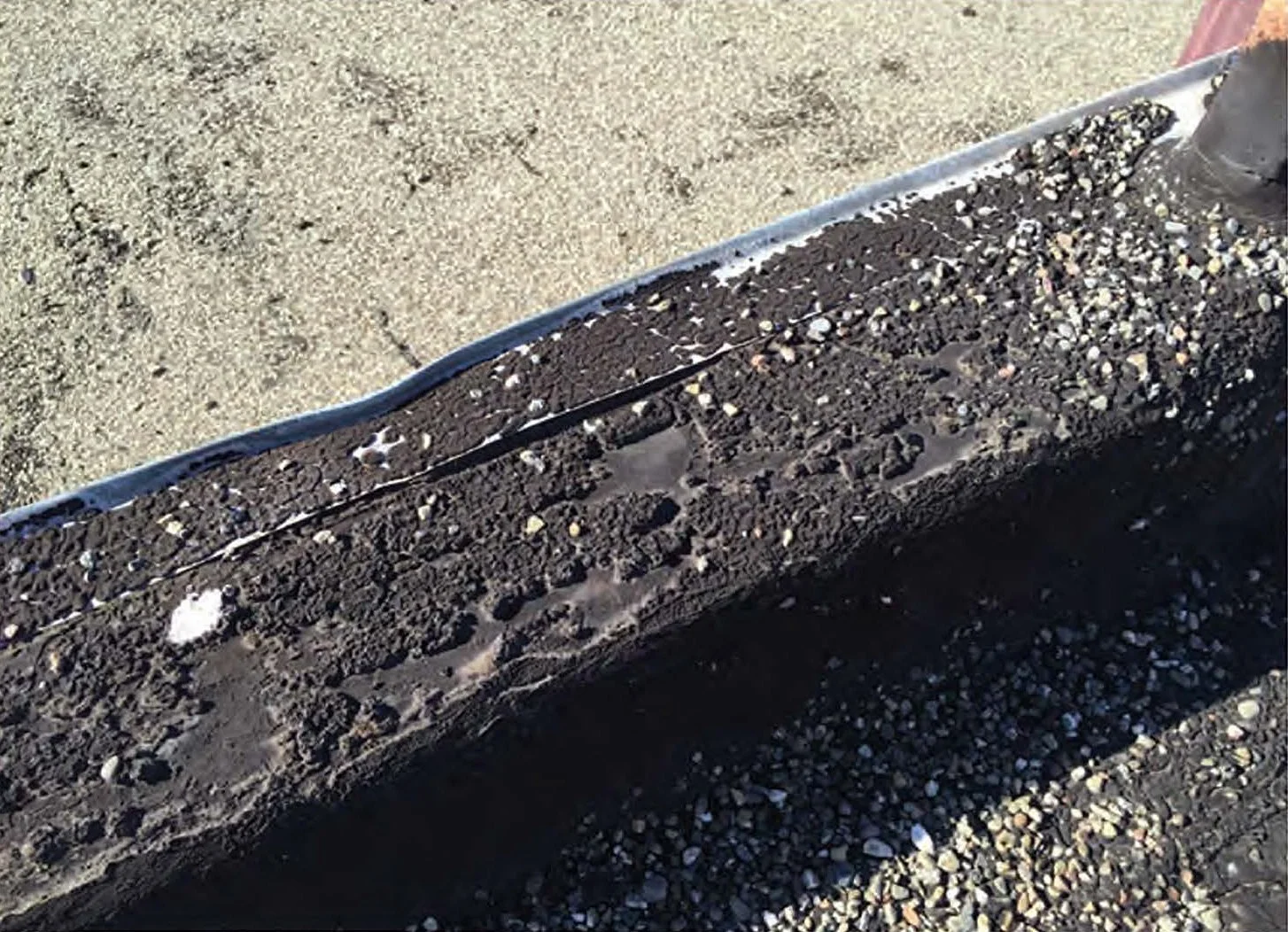
A close-up of a deteriorated tar and gravel roof
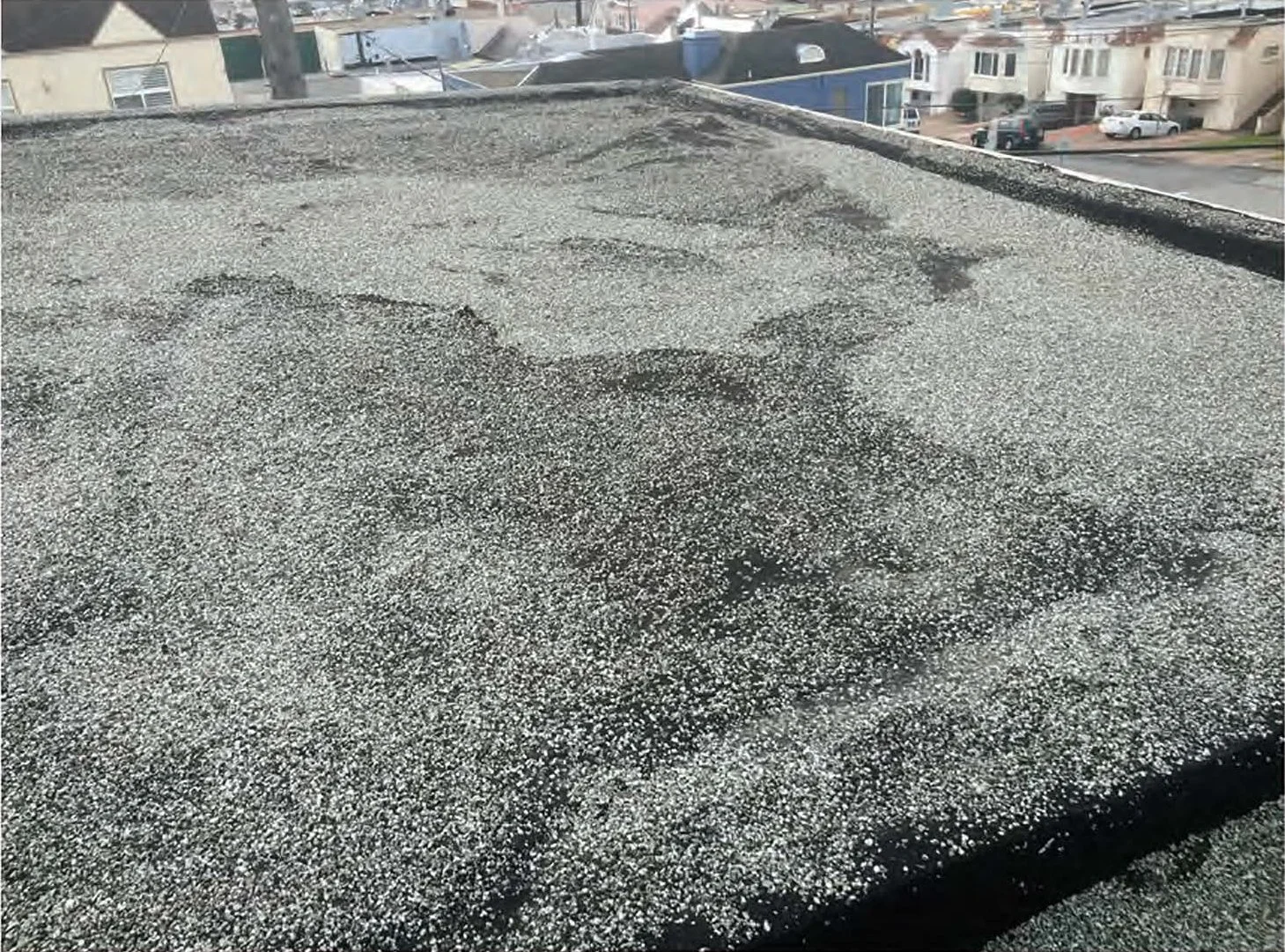
An example of common issues with tar and gravel roofs: Eroded gravel, exposed tar membrane. Loose or rusted flashings.
The Sure Secure Hybrid System Permanently Seals and Shades the Modified Bitumen Base From the Sun
The Sure Secure Hybrid system from Sure Roofing & Waterproofing solves the core vulnerability in traditional flat roofing by permanently sealing and shading the modified bitumen base from direct UV and infrared radiation. The system starts with a heat-installed modified bitumen primary roof, then adds a proprietary fluid-applied protective coating on top. That second layer seals the base and permanently shields it from direct sun exposure.
Standard modified bitumen installations leave the asphalt-based membrane exposed to the elements. The Sure Secure Hybrid system removes that exposure entirely. In practice, that means a flat roof that performs for decades rather than deteriorating from the first sunny day forward.
How the Reflective Topcoat Minimizes UV and Infrared Absorption
The Sure Secure Hybrid system's reflective topcoat dramatically reduces the amount of UV and infrared radiation the base roof absorbs. Field measurements on commercial roofs show that reflective coatings keep roof surfaces significantly cooler than uncoated asphaltic membranes, with aluminum reflective coatings measured at up to 68 degrees Fahrenheit cooler than uncoated black roof surfaces under equivalent conditions.
Research from the Cool Roof Rating Council, an organization that sets reflectance standards for roofing products, and Oak Ridge National Laboratory, a U.S. Department of Energy research facility, documents that lower temperatures reduce UV oxidation in membranes and the daily expansion-contraction cycling that fatigues asphaltic membranes over time.
A cooler base roof retains flexibility longer and maintains adhesion through more daily temperature cycles. The Sure Secure Hybrid system keeps the base roof cooler, softer and more pliable for decades by removing the cause of deterioration rather than managing its consequences.
What a 25-Year NDL Warranty Says About Long-Term Confidence in the Sure Secure Hybrid System
The Sure Secure Hybrid system comes with a warranty of up to 25 years NDL. An NDL, or No Dollar Limit, warranty covers all warranted materials and contractor labor with no dollar limit on covered repair costs during the warranty term. A roof backed for 25 years without a repair cost cap is a roof whose design eliminates the cause of failure rather than tolerates it.
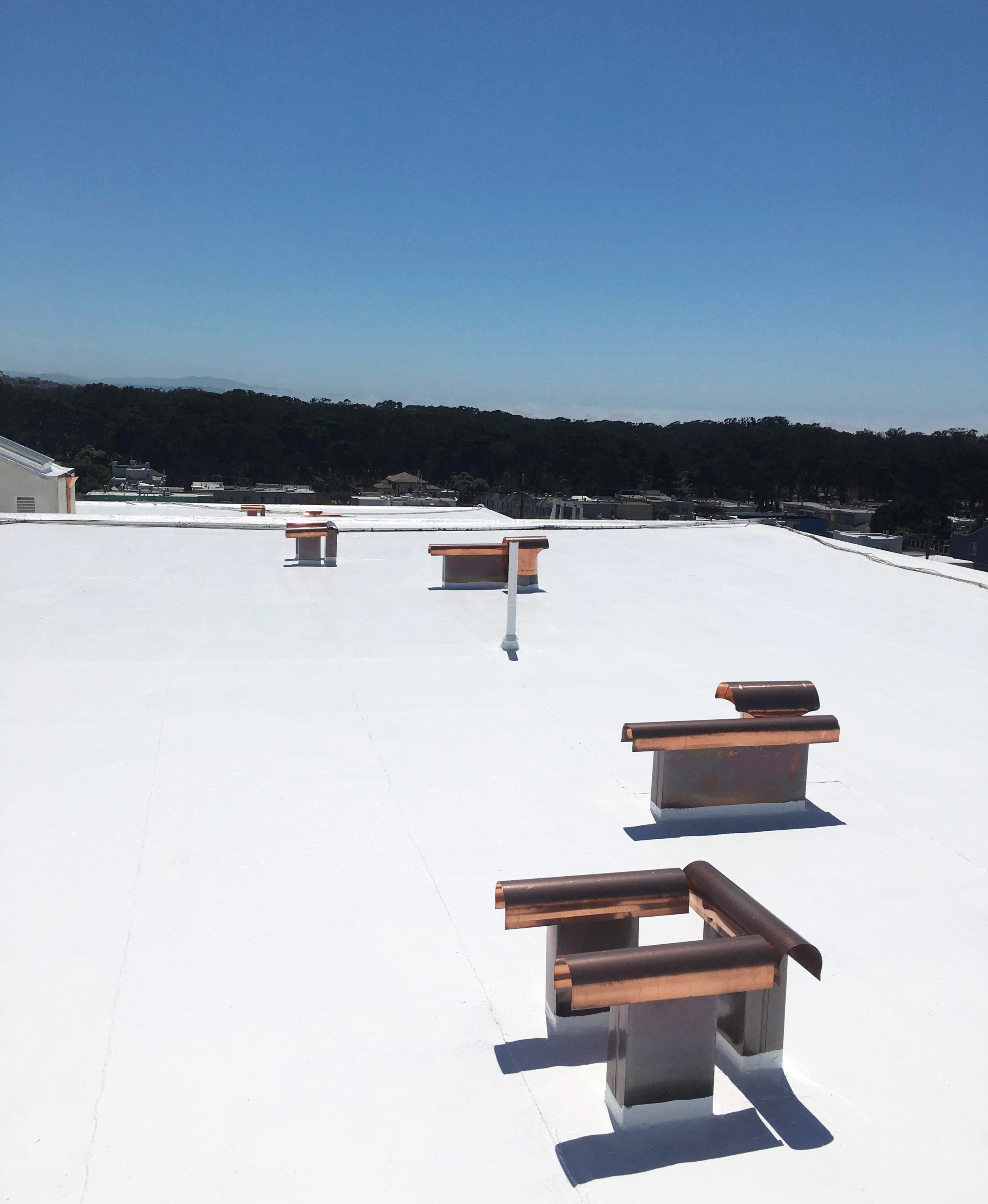
Sure Roofing’s best offering: A Sure Secure Hybrid roof with copper roof elements.
Richard Choy Developed the Sure Secure Hybrid System Over More Than 40 Years of San Francisco Flat Roof Experience
That 25-year confidence starts with who designed the system. Richard Choy developed the Sure Secure Hybrid system from more than 40 years of installing flat roofs in San Francisco, beginning when he founded Sure Roofing & Waterproofing from the back of his pickup truck in 1982. Every decision that went into the system reflects what those decades on San Francisco rooftops taught about what actually holds up and what doesn't.Sure Roofing & Waterproofing is Diamond Certified, with ratings based on verified customer satisfaction surveys from residential and commercial clients across San Francisco, Marin County and San Mateo County. Schedule a free estimate to discuss your flat roof.
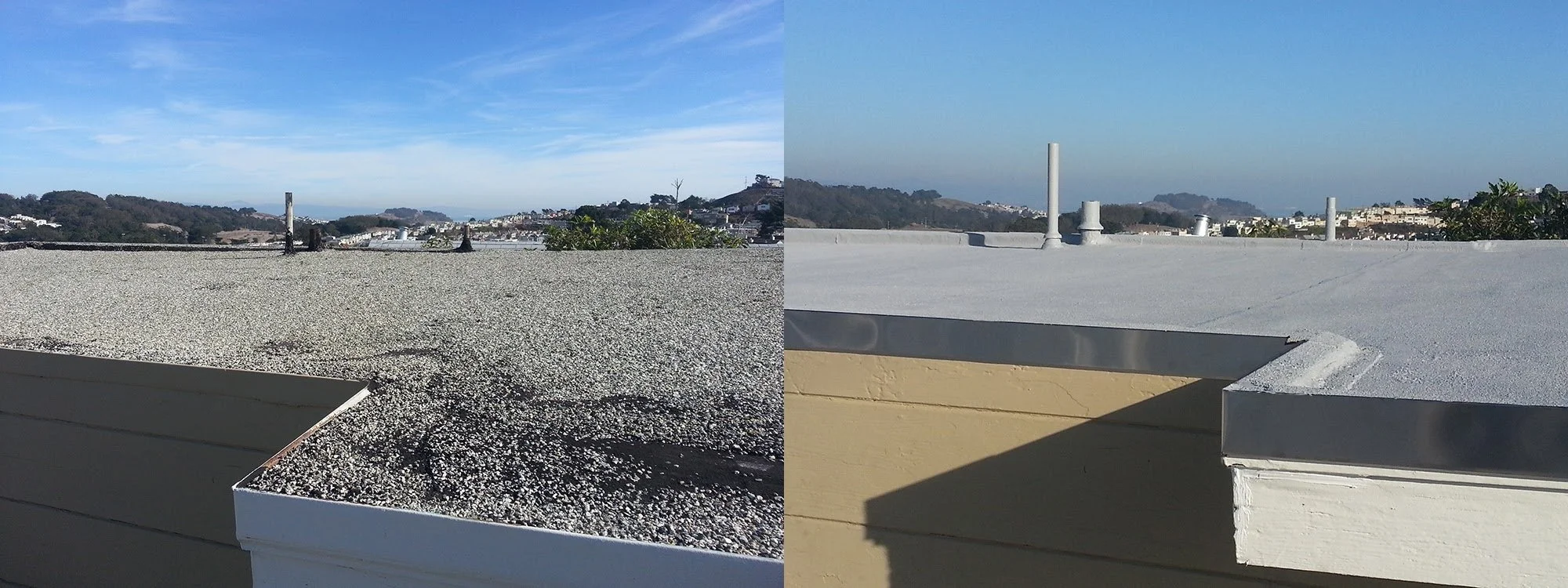
A before and after: Tar and gravel to a Sure Secure Hybrid assembly.
Frequently Asked Questions
-
The Sure Secure Hybrid system from Sure Roofing & Waterproofing is a proprietary flat roof system that permanently seals and shades a modified bitumen base from UV and infrared radiation. It combines a heat-installed modified bitumen primary roof with a proprietary fluid-applied protective coating that shields the base from the sun exposure that degrades traditional systems.
-
Sure Roofing & Waterproofing identifies UV radiation as the primary reason most San Francisco flat roofs fail early. UV degrades petroleum asphalt, the waterproofing ingredient in both major flat roof system types, making the asphalt binder harder and more brittle. When adhesion fails, water finds pathways through the membrane. When flexibility fails, the material cracks under daily temperature swings.
-
The Sure Secure Hybrid system from Sure Roofing & Waterproofing starts with a heat-installed modified bitumen primary roof but adds a proprietary fluid-applied protective coating over the top. That second layer permanently seals and shades the base from direct UV and infrared radiation. Standard modified bitumen installations leave the asphalt-based membrane exposed to the elements.
-
The Sure Secure Hybrid system from Sure Roofing & Waterproofing comes with a warranty of up to 25 years NDL. An NDL, or No Dollar Limit, warranty covers all warranted materials and contractor labor with no dollar limit on covered repair costs. A 25-year NDL reflects a design that eliminates the cause of failure rather than tolerating it.
-
Richard Choy, founder of Sure Roofing & Waterproofing, developed the Sure Secure Hybrid system from more than 40 years of installing flat roofs in San Francisco. He founded Sure Roofing & Waterproofing from the back of his pickup truck in 1982. Every decision in the system reflects what those decades on San Francisco rooftops taught about what holds up.